
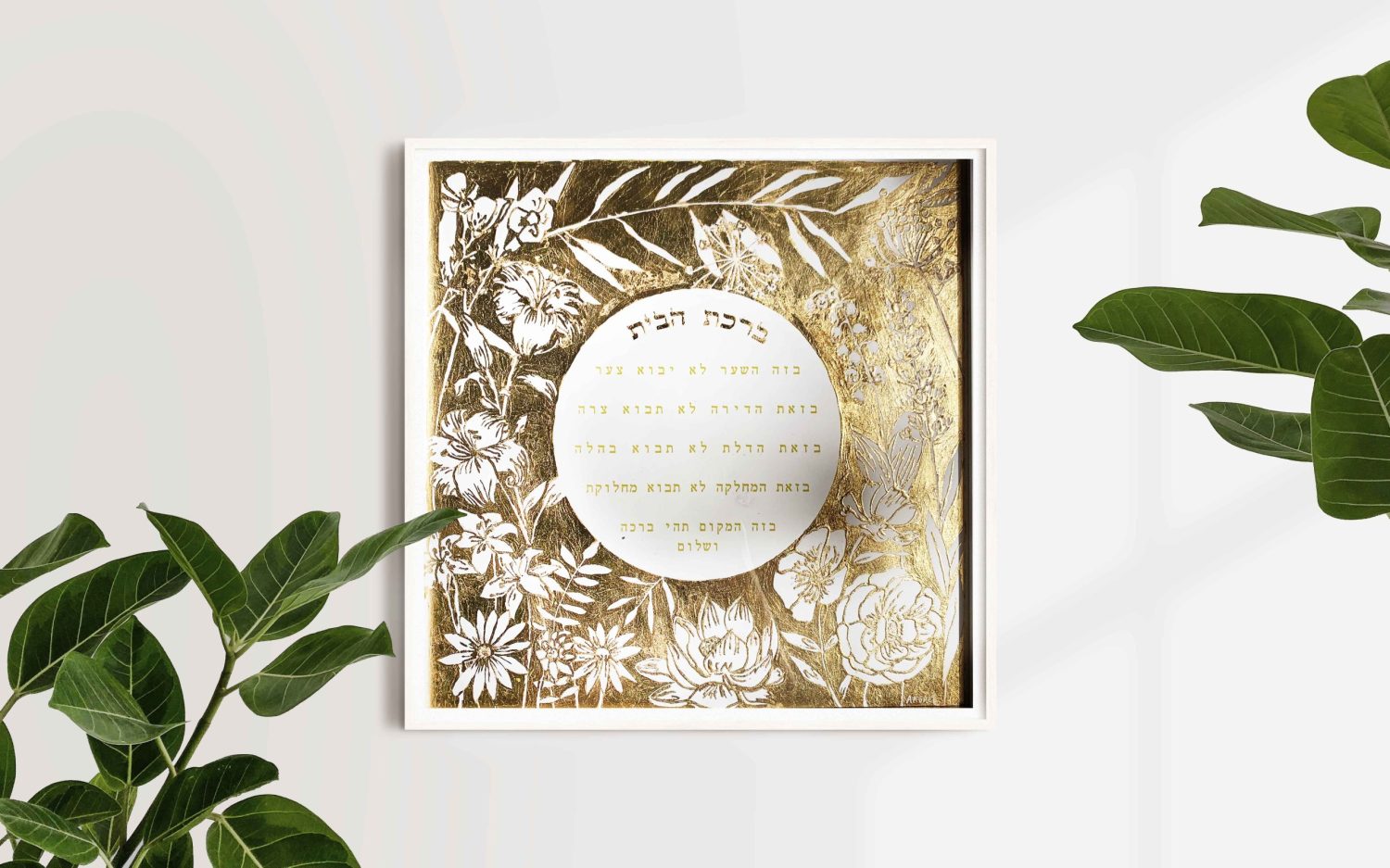
There are objects we bring into a home simply because we find them beautiful. And then there are objects that say something about the home we hope to create. For me, a Birkat HaBayit belongs to the second group. The Hebrew words express a simple wish: that the people living together will find peace, kindness and blessing in their shared space.
If you have seen these words on a painted plaque, a framed print or a piece of Judaica, you may have wondered what they actually mean. Here is a closer look at the Hebrew blessing for the home, with an English translation and some ideas for bringing it into everyday life.
What does Birkat HaBayit mean?
Birkat HaBayit (ברכת הבית) translates as “Blessing of the Home” or “Home Blessing.” It is a much-loved Jewish text expressing hopes for a peaceful household. You might see it written as Birkat Habayit, Birkat HaBayit or simply the Jewish home blessing.
Unlike a specific biblical commandment, this familiar five-line blessing is a popular Hebrew text with different versions. Its original author is not known. It is often displayed as a decorative piece near the entrance of a Jewish home, where its message becomes part of the everyday surroundings.
Birkat HaBayit in Hebrew
Here is one widely used version of the traditional text:
בִּרְכַּת הַבַּיִת
בזה השער לא יבוא צער.
בזאת הדירה לא תבוא צרה.
בזאת הדלת לא תבוא בהלה.
בזאת המחלקה לא תבוא מחלוקת.
בזה המקום תהי ברכה ושלום.
You may encounter slightly different spelling, punctuation or additional lines in other versions. That variety is part of the history of this popular home blessing.
Birkat HaBayit English translation
In natural English, the blessing can be expressed as:
May sorrow never enter through this gate.
May trouble never come to this dwelling.
May fear never pass through this door.
May disagreement have no place here.
May blessing and peace dwell in this home.
The beauty of these words is in their simplicity. They do not promise that life will always be easy. Instead, they express the kind of atmosphere we want to cultivate with the people we love.
The meaning behind the Hebrew words
The first line connects sha’ar (gate) with tza’ar (sorrow). The rhyme makes the message memorable: when we open our doors, we hope sadness will not follow us inside. The next lines extend that wish to the dwelling and the doorway, asking that trouble and fear remain outside.
Another line asks that machloket, or conflict, have no place in the home. Every family has moments of disagreement, of course. I understand this line as an invitation to choose patience and harmony, not as an expectation of a perfect life.
The closing words, bracha ve-shalom, mean “blessing and peace.” For me, that is the heart of Birkat HaBayit. A home is not defined only by its walls or furniture, but by the feeling created inside them.
Where should you hang a Birkat HaBayit?
Many people hang a Birkat HaBayit near the entrance, so the blessing is visible as family members and guests come in. Others choose the living room, a hallway or another meaningful place where everyone can see the words. There is no single decorative position that suits every home.
A Birkat HaBayit artwork is different from a mezuzah, which has its own specific religious significance and placement. The framed blessing is a personal way of expressing wishes for the household, rather than a replacement for the mezuzah.
Why is Birkat HaBayit a meaningful Jewish gift?
When someone moves into a new home, a Birkat HaBayit makes a thoughtful housewarming or Chanukat HaBayit gift. It celebrates not just the new address, but the life that will unfold there.
It is also a lovely Jewish wedding gift. For a couple beginning their life together, the blessing offers words about peace and kindness that can stay with them for years. Some families choose to add a surname or dedication, turning the artwork into something personal.
If you are choosing the artwork as a present, I would think first about the recipient’s home: the colors they enjoy, the space where they might display it, and whether a traditional or modern design feels more like them.
How I bring the blessing into my watercolor paintings
In my Jerusalem studio, I begin with the relationship between the Hebrew letters, the shapes and the color palette. Sometimes flowers frame the words. Sometimes the colors feel more abstract or energetic. I love the challenge of creating a composition that feels artistic while allowing the text to remain central.
My Birkat HaBayit pieces begin as original watercolor paintings and are reproduced as fine-art prints. Selected designs receive hand-applied metallic details, including gold leaf. I want the artwork to feel both contemporary and connected to the tradition behind the words.

You can explore the Birkat HaBayit art prints in my collection, including floral designs, Jerusalem-inspired pieces and works with gold accents. If you are choosing a piece for a particular room, my guide to choosing Birkat HaBayit wall art offers practical ideas about size, style and framing. You can also discover other Judaica fine-art prints inspired by Hebrew prayers and Jewish traditions.
A blessing to live with
What I love most about Birkat HaBayit is that the words stay relevant long after the artwork has been hung. They can greet us when we return after a difficult day, welcome friends at the door and remind us what matters within our family. A small piece of wall art can carry a very big wish: may this home be a place of blessing and peace.
For another version of the Hebrew wording and background on this home blessing, see the Open Siddur Project.


